What You Will Learn in This Article
- What personalised mRNA cancer vaccines are and how they work
- Why the United States is the only place in the world where you can realistically access them right now
- Which cancers and patients are currently eligible
- What the latest 2026 clinical trial results actually show
- How international patients from India, Saudi Arabia, Singapore, UAE, Japan and South Korea can access these treatments through MediPocket USA
The Question Every Cancer Patient Deserves an Answer To
“Is there anything else that can be done?”
If you or someone you love has been through chemotherapy, radiation, surgery — or all three — and is now facing recurrence, limited options, or a diagnosis with a historically poor prognosis, this question is not just valid. It is urgent.
In 2026, the answer coming out of America’s leading cancer centres is yes — and the treatment that is generating the most significant scientific excitement is one that most patients outside the United States have never been told about.
The personalised mRNA cancer vaccine.
What Is a Personalised mRNA Cancer Vaccine?
To understand why this treatment is different from anything that has existed before, you need to understand one fundamental truth about cancer: every tumour is genetically unique.
Your cancer is not the same as another person’s cancer — even if it has the same name, the same stage, and the same organ of origin. It has its own specific set of mutations, its own neoantigen signature, its own fingerprint. Standard chemotherapy and radiation don’t account for this. They attack everything — healthy and cancerous cells alike.
A personalised mRNA cancer vaccine does something entirely different.
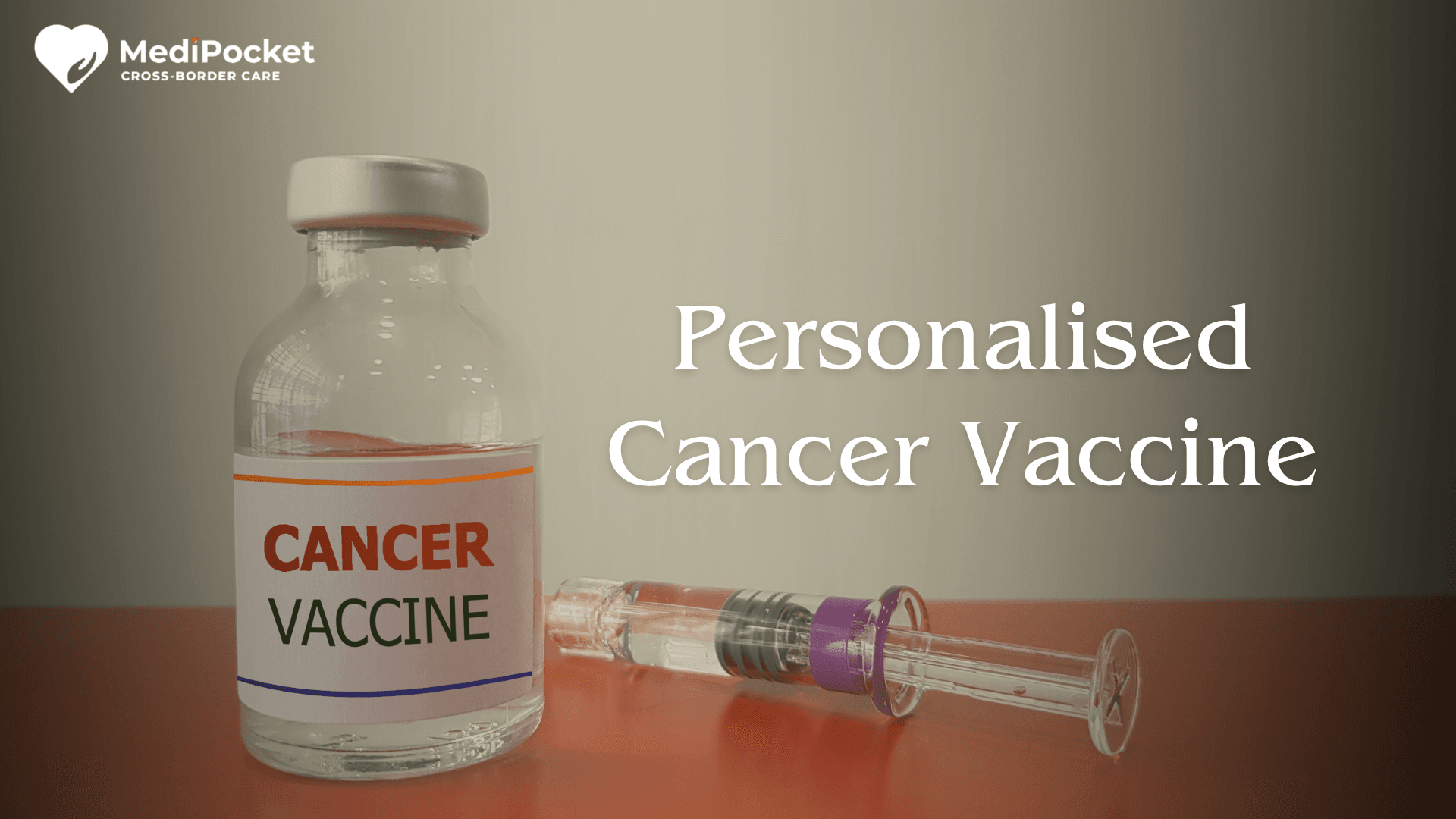
It begins with a sample of your tumour. That sample is genomically sequenced — scientists map the specific mutations unique to your cancer. An mRNA vaccine is then engineered to encode your tumour’s specific neoantigens — essentially a molecular wanted poster of your cancer — and administered to your body. Once the genetic sequencing of the tumour is identified, the mRNA vaccine is designed to target tumour-specific neoantigens, prompting a robust immune response.
Your immune system, now trained to recognise exactly what your cancer looks like at a molecular level, mounts a targeted, sustained attack — specifically against your cancer cells, not your healthy tissue.
This is not science fiction. This is happening in US cancer centres right now.
What the 2026 Data Actually Shows?
The clinical results emerging in 2026 are genuinely historic.
Pancreatic Cancer — One of the Deadliest Diagnoses in Oncology
Pancreatic cancer has a five-year survival rate of around 13% — one of the lowest of any cancer type. For decades, meaningful progress was almost nonexistent.
An experimental, individualised therapeutic cancer vaccine using mRNA to treat pancreatic cancer continues to show potential, with follow-up results from a phase 1 clinical trial showing that nearly 90% of people whose immune systems responded to the vaccine were still alive up to six years after receiving the last treatment.
Read that again. Six years of survival in a cancer where five-year survival sits at 13% for the general population.
Melanoma — Phase 3 Trial Underway
The industry is eagerly anticipating readouts from Merck and Moderna’s Phase 3 trial of adjuvant V940 in combination with Keytruda — a personalised mRNA vaccine that in Phase 2b trials showed a 44% reduction in recurrence or death compared to Keytruda alone in high-risk melanoma patients after surgery.
Breast Cancer — Hard-to-Treat Cases Showing Promise
A personalised mRNA vaccine has induced strong, durable immunity in hard-to-treat breast cancer, according to research published in Nature in early 2026 — covering triple-negative breast cancer, one of the most aggressive and treatment-resistant subtypes.
Lung Cancer — mRNA and Immunotherapy Converging
A study led by Drs. Adam Grippin and Steven Lin of MD Anderson Cancer Center found that getting an mRNA-based vaccine was linked to a significantly better response to cancer drugs, with patients with small cell lung cancer who had gotten a relevant mRNA shot within 100 days of starting treatment living nearly twice as long as those who hadn’t.
Why This Treatment Is Almost Exclusively Available in the USA Right Now
This is the critical point for every international patient reading this.
Personalised mRNA cancer vaccines are not available as standard treatment anywhere in the world yet. They are in active clinical trials — which means the only patients accessing them today are those enrolled in those trials, predominantly in the United States.
AI-powered biomarkers and patient-matching tools are poised to improve clinical trial enrolment rates by up to 26%, accelerating the development of targeted therapies — but without the right connections to these trials, most international patients will simply never know they qualify.
The US leads this field for several compounding reasons:
→ The NIH (National Institutes of Health) is the world’s largest public funder of biomedical research — directing billions into next-generation oncology
→ Institutions like MD Anderson, Memorial Sloan Kettering, Dana-Farber, Houston Methodist, and Mayo Clinic have the genomic sequencing infrastructure, the manufacturing capability, and the clinical trial volumes to run these programmes at scale
→ Advances in RNA bioinformatics, lipid nanoparticle delivery and in-house GMP manufacturing are converging to make individualised cancer vaccines feasible within US academic medical centre settings
→ The FDA’s accelerated approval pathways — Breakthrough Therapy Designation, Fast Track, Orphan Drug — move promising treatments from trial to patient access faster than any regulatory body in the world
→ January 2026 marks a pivotal month in oncology, with the FDA advancing numerous innovative therapies for challenging cancers, emphasising precision medicine
Outside the US, most countries are still observing these developments, not participating in them.
Which Cancers Are Currently Being Targeted?
Personalised mRNA cancer vaccines are being actively trialled across a growing number of cancer types. The most advanced programmes currently cover:
- Melanoma — most advanced trial stage, Phase 3 underway with Moderna + Merck
- Pancreatic cancer — Phase 1/2 results at Memorial Sloan Kettering showing extraordinary outcomes
- Triple-negative breast cancer — Phase 1/2 trials at multiple US centres
- Non-small cell lung cancer — BioNTech and Genentech running global trials for BNT116, primarily enrolling through US sites
- Colorectal cancer — genomic profiling trials in progress at multiple institutions Glioblastoma — brain tumour vaccine trials ongoing at Dana-Farber and MD Anderson
- Acute myeloid leukaemia (AML) — two targeted therapies called menin inhibitors were recently approved for approximately 40% of AML cases, and vaccine trials are being layered on top
Cancer researchers are approaching 2026 with a renewed focus on early detection and prevention, personalising treatment, and closing gaps in care — with advances in precision tools that refine therapy choices and immunotherapies designed for hard-to-treat tumours.
Who Qualifies as an International Patient?
The eligibility question is one MediPocket answers for patients individually — because trial criteria vary significantly by institution, cancer type, stage, and prior treatment history. However, the general qualifying principles across most personalised vaccine trials are:
→ A confirmed cancer diagnosis with documented pathology and imaging → Tumour tissue available for genomic sequencing (either existing biopsy or new sample) → Prior standard treatment completed or ongoing with documented response/non-response → Performance status sufficient to tolerate trial participation → No active serious infections or competing immunological conditions → Willingness to travel to the US for treatment visits if required (some trial phases can be partially coordinated remotely)
International patients are eligible for US clinical trials. There is no citizenship or residency requirement. It is necessary to expand clinical trials by including more diverse patient groups worldwide so that benefits are broadly generalisable and access is equitable — and leading US institutions actively welcome international enrolment.
The Real Barrier — And How MediPocket Removes It
The personalised mRNA cancer vaccine exists. The trials are open. International patients are eligible.
So why aren’t more patients from India, Saudi Arabia, Singapore, UAE, and Japan accessing them?
Because no one told them. And no one showed them how.
Navigating US clinical trial access as an international patient involves:
- Identifying which institution is running the right trial for your specific cancer subtype
- Having your medical records reviewed and formatted to meet US institution requirements
- Getting a genomic pathology report that meets the trial’s molecular eligibility criteria
- Coordinating with the trial’s principal investigator for international patient enrolment
- Managing the visa process, travel logistics, and treatment coordination simultaneously — Understanding what is covered by the trial vs what needs to be privately funded
- Most patients and most oncologists outside the US — don’t have the connections or the process knowledge to do this. That is precisely the gap MediPocket was built to close.
Here is what MediPocket does for patients pursuing US cancer treatment and clinical trial access:
✔ Physician-led case review — your full medical history reviewed by Dr. Priyanka Mathur and her team before any institution is approached
✔ Specialist and trial matching — identifying the most relevant US institution and trial based on your cancer’s genomic profile and treatment history
✔ Medical record preparation — complete formatting, translation where needed, and submission to the US institution
✔ Upfront coordination — direct communication with the clinical team before you travel anywhere
✔ Pricing transparency — full cost breakdown negotiated before you commit
✔ Visa and travel support — medical visa documentation, accommodation, ground transfers
✔ On-ground coordination — MediPocket’s team stays with you through treatment, not just until arrival
✔ Post-treatment remote follow-up — once you return home, the relationship doesn’t end
Frequently Asked Questions
Q: Can I access a personalised cancer vaccine in the US without living there? Yes. International patients are eligible for US clinical trials and US private oncology care. MediPocket coordinates the entire process so you don’t need to navigate it independently.
Q: Does the treatment require me to stay in the US for the full duration? It depends on the trial protocol. Some phases require periodic visits rather than continuous residency. MediPocket clarifies the exact schedule before you commit to anything.
Q: How much does personalised cancer vaccine treatment cost in the USA? Clinical trial participation is often partially or fully funded — meaning some or all treatment costs are covered. MediPocket negotiates and clarifies exact costs before you travel.
Q: My oncologist said there are no more treatment options. Does that mean I don’t qualify? Not necessarily. Many patients told there are no more options at home qualify for US trials. MediPocket’s physician-led case review is specifically designed to assess this gap. The answer costs you nothing to find out.
Q: Which countries does MediPocket serve? India, Saudi Arabia, UAE, Singapore, Japan, South Korea, China, Kuwait, Qatar, Malaysia and beyond. If you have a complex cancer case and are researching your options — MediPocket is built for you regardless of where you are.
The Bottom Line
The five-year relative survival rate for all cancers in the United States has reached a historic milestone of 70% — up from 49% in the mid-1970s. Perhaps most striking are the dramatic gains in survival for advanced, metastatic cancers that were often considered untreatable just a generation ago.
That number is not an accident. It is the direct result of the research infrastructure, the clinical trial access, and the precision medicine ecosystem that the US has built — and that no other country has yet matched.
Personalised mRNA cancer vaccines are the most significant development in oncology of the last decade. In 2026 they are not theoretical. They are being administered to real patients, showing outcomes that were considered impossible five years ago, and they are available — if you know how to access them.
MediPocket knows how.
📩 Start your case today — no paperwork, no commitment, just a conversation. If you have a cancer diagnosis and want to understand whether US treatment or clinical trial access is right for your case, contact MediPocket USA directly.
🌐 medipocketusa.com 💬 WhatsApp: +1 818 235 3291 📧 health@mymedipocket.com
One conversation could change everything.